Outdoor Running
Hill Sprints and the Logic of Outdoor Running in an Urban Setting
Eleanor Whitfield
·
·
10 min read
The push-up, viewed from a programming standpoint, is not a single exercise. It is a movement family encompassing at least seven structurally distinct variations, each loading the anterior musculature from a different angle and demanding a different calibration of stabiliser engagement. A complete calisthenics-based training programme that regards the push-up as one unchanging action is leaving a substantial portion of its adaptation potential unused.
This record documents the push-up progression sequence in the order it appears across published peer-reviewed movement research and in the applied practice observed across London's outdoor training spaces — from the public park installations of Islington and Hackney to the concrete ledges and benches that serve as improvised training apparatus throughout the city. The sequence is consistent. The rationale behind each step is instructive.
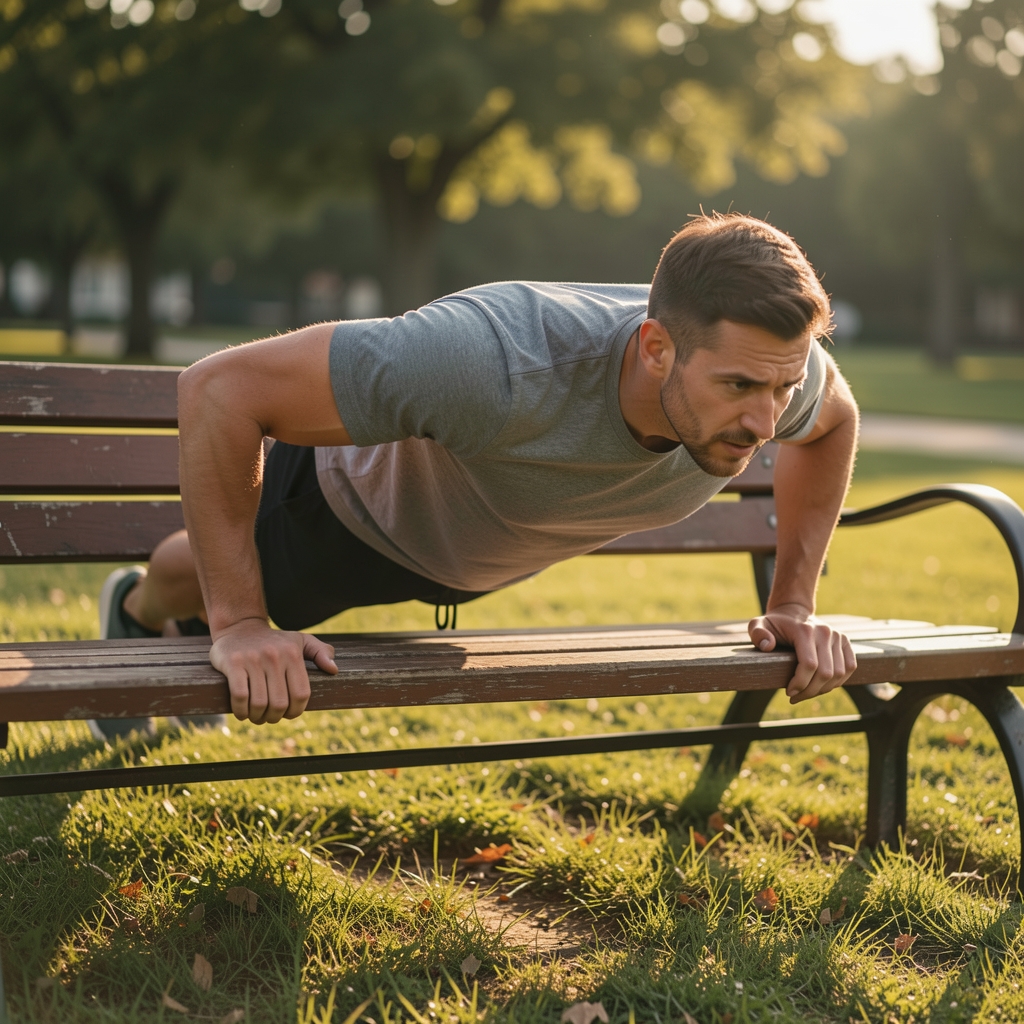
Wall-supported push-ups and incline variants represent the entry tier of the progression. Both reduce the proportion of bodyweight bearing down on the upper limbs by elevating the hand position. A wall push-up, where the hands are placed flat against a vertical surface at approximately chest height, positions perhaps fifteen to twenty percent of total body mass into the push. An incline push-up from a park bench — a surface consistently available across most urban green spaces in England — places somewhere between thirty and forty-five percent, depending on bench height and individual body composition.
The value of the incline tier is often underestimated. For individuals returning to structured movement after a period of inactivity, the reduced load of incline variants allows correct form to be established without the postural compromises that appear when load exceeds current capacity. Specifically: the tendency to let the hips drop toward the ground, the shortening of the movement range to avoid the point of greatest demand, and the lateral elbow flare that reduces shoulder efficiency. All three compensations are observable under excessive load; incline variants almost entirely remove the structural incentive for them.
The standard floor push-up — hands placed slightly wider than shoulder-width, body held in a rigid plank line, elbows tracking at approximately forty-five degrees from the torso — constitutes the reference position from which all other variants are measured. Research consistently identifies the anterior deltoid, pectoralis major (sternal and clavicular heads), and triceps brachii as the primary load-bearing structures in this position, with the serratus anterior playing an important stabilising role at the lower tip of the shoulder blade.
Practical observation across no-equipment training environments confirms what movement analysis suggests: the greatest challenge in progressing from incline to standard floor position is not load management but positional control. The plank position requires isometric engagement of the entire posterior chain — glutes, spinal erectors, deep abdominals — to prevent the hip-drop compensation. Integrating a plank series into training specifically prepares this holding capacity. A minimum of three to four weeks of consistent plank holds (progressing from twenty to sixty seconds over multiple sets) provides the prerequisite stabilisation for clean floor push-up execution.
Elevating the feet above hand level — the decline push-up — shifts the primary loading emphasis from the lower pectoralis toward the clavicular (upper) pectoral head and increases the contribution of the anterior deltoid. In terms of perceived effort, most practitioners find the decline variant significantly harder than the standard position at an equivalent number of repetitions, which makes it a natural programming step after the standard position is consolidated.
The outdoor training environment is particularly well-suited to decline progression. Benches, low walls, stair steps, and the edges of outdoor gym installations all provide surfaces at varying heights, giving access to a continuum of angles without any specialised equipment. A park bench seat at approximately forty centimetres from the ground represents a modest elevation; placing the feet on the back-rest of the same bench, if geometry allows, produces a substantially steeper decline that targets the upper anterior musculature under significantly greater demand.
It is worth noting that the decline variant taxes the wrist flexors and extensors more substantially than standard floor work. Individuals who have not developed wrist mobility and loading tolerance through incline and standard work may find the decline variant produces joint discomfort at the wrist before the target musculature reaches its working threshold. Including dynamic wrist circles and bodyweight-loaded wrist extension holds as part of the session warm-up addresses this systematically.
The pike push-up involves transitioning from a standard push-up starting position into an inverted V-shape, where the hips are driven high and the head drops between the arms. From this position, the lowering phase is primarily driven by the deltoids, with minimal pectoral involvement. The movement approximates a portion of the mechanics of an overhead press without requiring any overhead apparatus, making it a significant progression tool for developing shoulder capacity within a no-equipment framework.
The archer push-up, by contrast, introduces lateral loading. From a wide hand placement, the body is lowered toward one side as the opposite arm extends fully straight, acting as a non-load-bearing guide. The asymmetry substantially increases the demand on the pushing side and begins to approach the loading profile of a single-arm push-up. Archer variants require a high degree of core stability — specifically oblique engagement — to prevent the body from rotating during the movement.
Both variants are achievable on open ground. Neither requires any additional hardware beyond a flat surface. This is precisely why they appear consistently in documented no-equipment workout frameworks: they produce observable adaptation in the upper-body musculature through geometric complexity rather than external load.
A well-structured home training programme places push-up progressions on two to three non-consecutive days per week, allowing forty-eight to seventy-two hours of recovery between sessions. Within each session, the push-up work is typically preceded by a mobility drills sequence addressing shoulder girdle, thoracic spine, and wrist mobility, and followed by a plank series maintaining the isometric holding capacity that supports clean execution of all variants.
The progression logic is conservative: add a more demanding variant only when the preceding tier can be completed across three sets at the target repetition range with consistent technique across all repetitions. A useful observable marker for technique consistency is the maintenance of a neutral head position — neither tucked toward the chest nor extended back — throughout the full range of each repetition. Loss of head position reliably precedes form breakdown in the torso and arms.
The six-step progression sequence documented here — wall, incline, standard, decline, pike, archer — provides a structured pathway from no prior upper-body capacity to a functionally robust calisthenics baseline. Each step is distinct, each builds on the last, and none requires anything that cannot be found in a standard English urban park or in the open space of a living room. That accessibility is not incidental to the method. It is the method.
Karinela Dispatch returns to specific topics within this progression — notably the integration of pull-up alternatives and the scheduling interface between push-pull balance — in forthcoming editorial work. The push-up as a research subject has not been exhausted by this record. It has only been started.

Tobias Ashcroft is the primary editor of Karinela Dispatch, with a background in movement research documentation and a long-running practice of outdoor bodyweight training across London's park network. His editorial focus centres on the practical application of published movement science to no-equipment training environments.
More from this author