Calisthenics Basics
The Case for Calisthenics: Push-Up Progressions and What They Build
Tobias Ashcroft
·
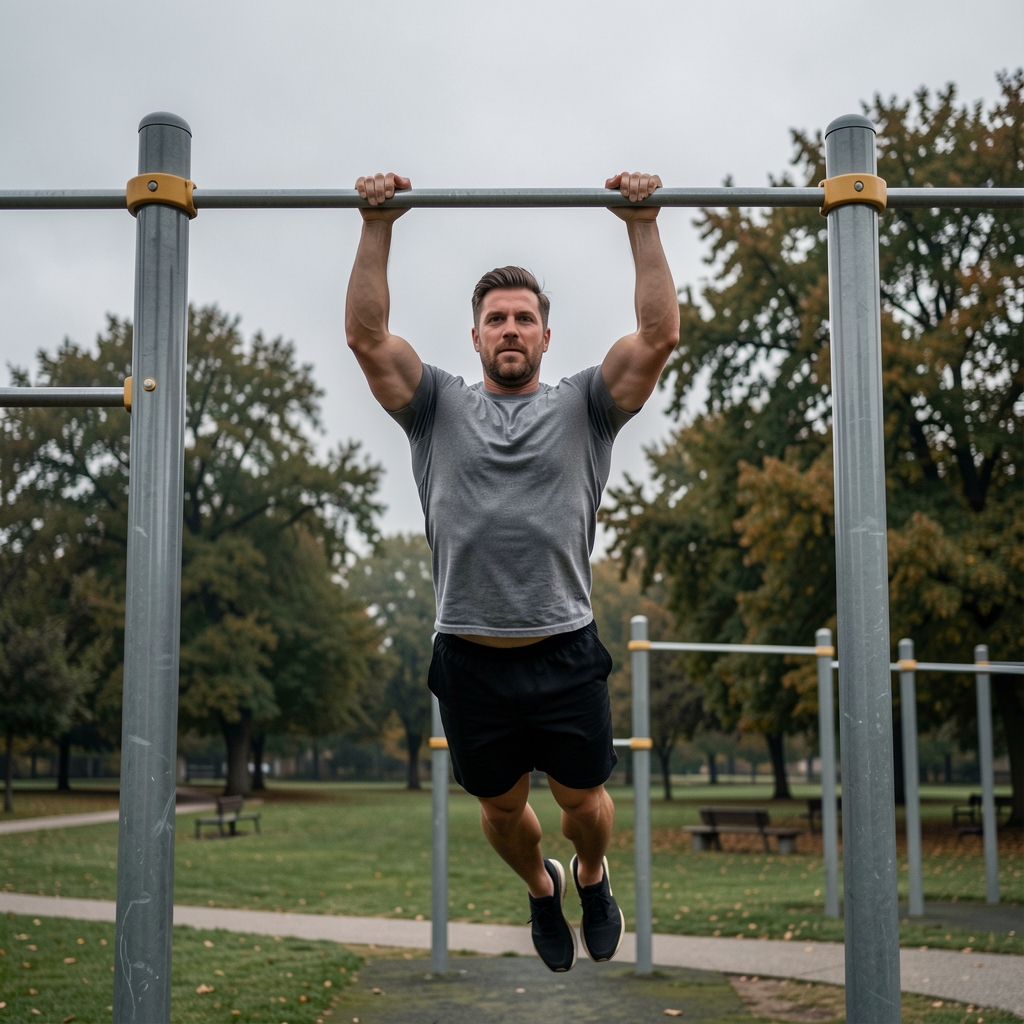
Functional movement describes the category of physical patterns that underpin the actions of ordinary life: pulling, pushing, hinging, squatting, carrying, and rotating. A training approach built around these patterns does not require gym machinery to be effective. The horizontal bar at a public park installation, the parallel rails of a playground structure, and the open ground of a municipal green space constitute a sufficient functional movement environment for the majority of a well-designed no-equipment programme.
The term functional movement is used loosely in fitness writing. In its precise application, it refers to multi-joint movement patterns that transfer directly to the physical demands of daily life and occupational tasks. The key patterns — vertical pulling, horizontal pushing, bilateral and unilateral squat variants, hip hinge movements, and loaded carry — each correspond to a distinct category of muscular and neurological demand. Training that addresses all six patterns across a weekly structure develops a more complete physical capability profile than single-joint machine-based work.
Within a bodyweight-only framework, vertical pulling is the pattern most commonly left unaddressed. Without a horizontal bar, the pulling musculature — the latissimus dorsi, rhomboids, rear deltoid, and biceps — receives no direct training stimulus from standard floor-based calisthenics. This is the practical reason why access to a park installation or playground bar matters for a complete home training programme: it is the only structure that enables the vertical pull pattern without equipment purchase.
The good news for men training in urban England is that public outdoor gym installations — present in a substantial proportion of London's parks and increasingly common in municipal green spaces across other English cities — provide horizontal bars at various heights. These enable pull-up alternatives including bar hangs, scapular retractions, assisted negative pull-ups using a bench, and eventually full pull-ups, covering the entire vertical pull progression sequence from entry-level to advanced.
A structured pull-up progression begins not with the pull-up itself, but with preparatory work that develops the neurological patterns and structural capacity the exercise requires. The sequence below is drawn from peer-reviewed exercise programming literature and field observation of park-based training practice.
Dead hang: Passive suspension from a horizontal bar with extended elbows, shoulders relaxed. This develops grip strength, shoulder girdle stability, and spinal decompression. Entry-level target: 30 seconds continuous. Intermediate: 60 seconds. This is the foundation of all bar-based pulling work.
Scapular pull: From a dead hang, retract and depress the shoulder blades without bending the elbows. This isolates the initial movement of the pull-up — the engagement of the lower trapezius and serratus anterior — which is frequently the limiting factor in people who cannot yet complete a full pull-up. Three sets of five to eight scapular pulls, performed deliberately and with full range, address this deficit directly.
Negative pull-up: Begin at the top position of a pull-up (using a bench or jump to get into position) and lower the body under control over three to five seconds to a full dead hang. This eccentric-only variant builds pulling strength in the range where most beginners lack capacity, without requiring the full concentric strength a complete pull-up demands.
Band-assisted pull-up: A resistance band looped over the bar and under the feet reduces the effective bodyweight being lifted, enabling full-range pull-up repetitions before unassisted strength has fully developed. Progressive reduction of band resistance — from a heavier to a lighter band over eight to twelve weeks — provides a measurable and continuous progression pathway to unassisted work. For men training in parks without resistance bands, the negative pull-up and scapular pull combination provides an equivalent entry pathway.
A survey of twelve public outdoor gym installations across six London boroughs found that eleven of the twelve sites provided at least one horizontal bar at a height suitable for pull-up work. Nine sites provided parallel bars at waist height, enabling dip-equivalent pushing patterns. Seven sites included inclined surfaces or balance beams that serve as platforms for incline push-up variants. The infrastructure for a complete functional movement session was present at the majority of surveyed locations.
Mobility drills and flexibility routines serve a structural role in a training programme rather than being supplementary activities. Restricted hip mobility limits squat depth and stride length. Restricted thoracic extension impairs overhead pressing mechanics. Tight hip flexors — a near-universal consequence of prolonged sitting — alter pelvic position during running, which loads the lumbar spine disproportionately over time. Each of these constraints is addressable through targeted mobility work placed at appropriate points within the session structure.
A ten-to-fifteen minute dynamic flexibility routine at session open addresses the range-of-motion constraints most relevant to the following session's movement demands. For a lower-body session involving squat variations and hip hinge work, this routine would prioritise hip flexor stretching, ankle dorsiflexion mobilisation, and thoracic rotation. For an upper-body session, shoulder circles, chest-opening stretches, and wrist flexor preparation are the priority sequences.
The plank series, while most commonly categorised as a core-strength exercise, also functions as a mobility assessment tool. The plank hold reveals anterior pelvic tilt — visible as a sagging lower back — and shoulder instability — visible as protracted or elevated shoulder blades. Correcting these positions under low-load isometric conditions develops the postural awareness that transfers directly to the movement quality of more demanding exercises. A progressive plank series moving from standard plank through side plank, single-leg plank, and RKC plank provides a structured four-stage progression.
Static flexibility work — prolonged holds of thirty to ninety seconds — is most effective when placed after the main session, during cool-down. Research into the timing of flexibility work is consistent on this point: pre-session static stretching reduces force output in subsequent strength work, while post-session static stretching, performed on already-warm tissue, produces greater lasting gains in range of motion. The structural recommendation is therefore: dynamic mobility at open, static flexibility at close.
"The horizontal bar at a public park installation constitutes a sufficient functional movement environment for the vertical pull pattern."
Karinela Dispatch — London, 2026
The squat is the fundamental bilateral lower-body movement pattern, loading the quadriceps, gluteal complex, and posterior chain across a deep range of motion. Within a no-equipment home training programme, the bodyweight squat is the entry point, but it is not the limit. A progression framework for squat variations covers at least five distinct stages, each introducing additional mechanical complexity or load.
The box squat — squatting to a seated position on a low surface before standing — reduces the range of motion and teaches the hip hinge cue required for safe deep-squat form. The standard bodyweight squat follows, with attention to knee tracking over the second toe and maintenance of a neutral spine through the range. The pause squat, holding at the bottom position for two to three seconds, develops positional strength and flexibility simultaneously. The jump squat adds a plyometric demand — a brief period of airborne deceleration — that develops power output in the lower-body pushing pattern.
The pistol squat — a single-leg full-depth squat — represents the advanced end of the bodyweight squat progression sequence. Very few men without specific training history can achieve a full pistol squat immediately; the progression to it typically requires twelve to twenty-four weeks of consistent bilateral squat work and targeted unilateral preparation through Bulgarian split squats and single-leg box squats. Its inclusion here is as a long-term direction marker, not an immediate target.
Vertical pulling — the most commonly absent pattern in floor-only programmes — requires access to a horizontal bar. Urban parks in England provide this at the majority of outdoor gym installations, making park-based training a viable substitute for gym-based pulling work.
The pull-up alternative sequence — dead hang, scapular pull, negative pull-up, assisted pull-up — provides a complete entry-to-advanced progression without additional equipment beyond a fixed horizontal bar.
Dynamic mobility at session open and static flexibility at session close is the evidence-referenced placement structure. Reversing this order reduces subsequent strength output and limits long-term range-of-motion development.
Daily step count of 8,000–10,000 is the baseline movement volume target. For men with sedentary working routines, active commuting and incidental movement are the most efficient means of meeting this target without additional scheduled sessions.
Resistance band training occupies a useful intermediate space between pure bodyweight work and loaded exercise. Bands provide accommodating resistance — the load increases as the band stretches further — which produces a distinct mechanical stimulus compared to constant-load barbell or dumbbell work. For the specific purpose of pull-up progression, bands serve as a measurable load-reduction tool. For other patterns, they introduce resistance to movements otherwise limited to bodyweight-only loading.
A light resistance band adds meaningful load to bodyweight row patterns (anchored to a fixed horizontal surface), standing hip abduction work (which targets the gluteus medius, a frequently undertrained stabiliser), and face pulls (a posterior shoulder and upper-back pattern that counteracts the forward-shoulder posture common in desk workers). Each of these addresses a gap in the standard floor-based calisthenics framework.
The practical case for including one or two resistance bands in an otherwise equipment-free training kit is strong: they are compact, low-cost, and provide the resistance variation that enables the bodyweight training framework to address its primary structural gaps. For men committed to training entirely without equipment purchase, the park horizontal bar and bodyweight-only pull-up alternatives address the pulling deficit adequately, though the progression timeline is typically longer than the band-assisted route.

Jasper Marsden is a guest contributor to Karinela Dispatch, writing on functional movement frameworks, outdoor training environments, and the application of published exercise science to practical no-equipment programming. His field work focuses on urban park infrastructure in England.
Related reading →